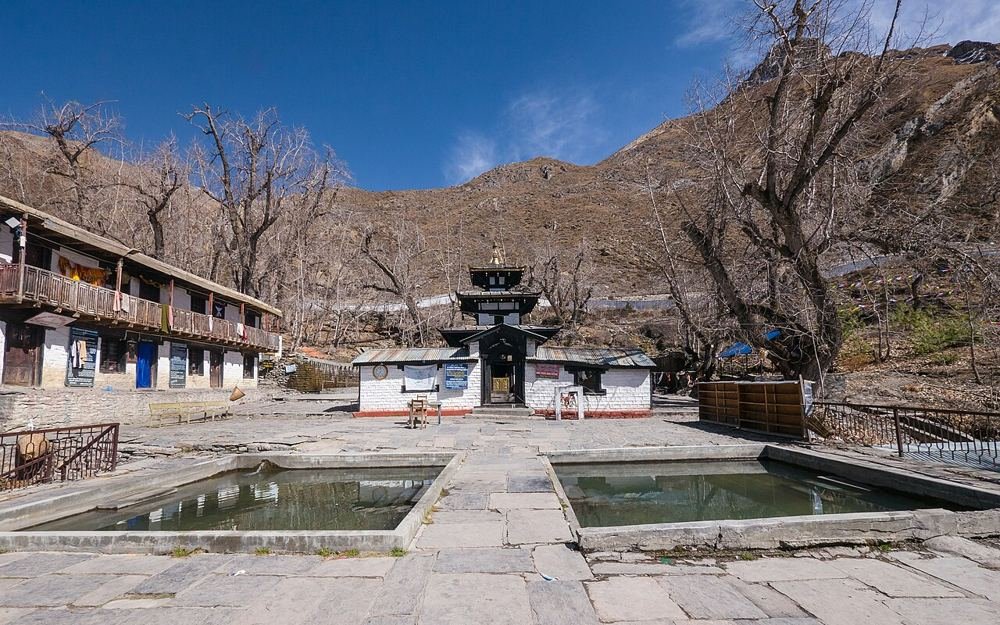
About Muktinath
Muktinath is one of the few places in the Himalaya that both Hindus and Buddhists treat as holy. Hindus come for moksha, liberation from the cycle of rebirth; Buddhists know it as Chumig Gyatsa, one of the twenty-four tantric places of the dakini.
The temple compound has 108 stone spouts fed by a glacial spring, and behind it a small flame burns from a seep of natural gas under running water. After Thorong La, the courtyards feel almost warm.
Highlights
- The 108 water spouts
- Jwala Mai, the eternal flame
- Jharkot and Kagbeni on the descent
Interesting facts
- Altitude 3,760 m.
- The 108 spouts represent the 108 names of Vishnu.
Famous for
The temple of liberation, holy to both Hindus and Buddhists.
Practical
Questions people ask
Why is Muktinath holy?
Hindus consider it a place of liberation, and Buddhists revere it as Chumig Gyatsa, a tantric site of the dakinis.
Can you drive from Muktinath to Jomsom?
Yes, the road runs down the Kali Gandaki to Jomsom in about two hours.
On these routes
On the map
Coordinates 28.8170 N, 83.8710 E · 3,760 m above sea level
Photo: Faj2323 · CC BY-SA 4.0 · Wikimedia Commons