


The Annapurna Circuit in 2026: What’s Changed and What Hasn’t
The Annapurna Circuit remains, in 2026, one of the great walks of the world — a route that climbs from subtropical rice terraces near 800 metres to the windswept Thorong La at about 5,416 metres, then drops through the deep, dry gorges of the Kali Gandaki past the sacred town of Muktinath. What has changed is the road, the logistics, and the way a smart trekker approaches the walk. What has not changed is the scale of the mountains, the warmth of the villages, and the sheer satisfaction of standing on that pass with the whole Himalaya spread beneath you.
This guide is the 2026 update: it tells you the current state of the trail, the permits and rules that apply this year, the realistic day-by-day shapes, the seasons, the costs, the altitude plan, and how Annapurna Circuit Treks — based in Pokhara under owner Anish Maharjan — runs the Circuit now that vehicles have reshaped the lower valleys. If you read about the Circuit a decade ago, read this before you book, because the trip you remember is not quite the trip you will walk.
The Route at a Glance: From Pokhara to the Pass and Back
The classic Circuit loops the Annapurna massif anti-clockwise. From Pokhara you reach the Marsyangdi valley (traditionally via Besishahar, now more often by road to a higher start), walk up through villages like Bhulbhule, Chamche, Tal, and Chame, into the dramatic alpine gorge toward Manang at about 3,540 metres. After a rest day you climb to Thorong Phedi or High Camp, cross Thorong La at 5,416 metres, and descend to Muktinath (about 3,800 metres), a sacred site for Hindus and Buddhists alike.
From Muktinath most 2026 trekkers take a vehicle or short flight toward Jomsom and out, rather than walking the long, road-bound lower Kali Gandaki. The loop can be extended with Tilicho Lake (about 4,949 metres) or closed early at various points. Our full Annapurna Circuit guide and Annapurna Circuit trek package map the standard version; the shape below is the modern, vehicle-assisted take that most trekkers now choose.
How the Roads Have Reshaped the Walk
The biggest 2026 reality is the road. A motorable track now follows much of the Marsyangdi and the lower Kali Gandaki, which means the ‘wilderness walk’ of legend is broken in places by dust, lorries, and construction. Purists mourn it; pragmatic trekkers use it. The modern Circuit is a hybrid: drive the dull, dusty, hot lower miles, and walk the scenic, high, beautiful sections where the road either does not go or is not worth driving.
Annapurna Circuit Treks builds the 7-day 4×4 drive to Manang and Tilicho and the standard 15-day Circuit with Tilicho around this truth, using vehicles for the road-affected stretches and reserving your feet for Manang, the Thorong approach, and the pass. The road also improves rescue access and re-supply, which is a quiet safety win. The honest summary: the Circuit is no longer a remote walk start to finish, but its high core is as magnificent as ever, and the road is a tool to be used, not a betrayal to be mourned.
Permits and Rules for 2026
In 2026 every trekker in the Annapurna Conservation Area needs two things: the ACAP (Annapurna Conservation Area Project) entry permit and the TIMS card. Both are arranged in Pokhara on arrival, usually within a day, and a licensed guide is mandatory in protected areas since 2023 — you cannot legally walk the Circuit unguided. The ACAP fee funds rangers and community programmes; the TIMS card is your safety-tracking record checked at various points.
Our Annapurna trekking permits 2026 guide details current costs and lead times, and our do-you-need-a-guide guide explains the 2026 requirement. Annapurna Circuit Treks completes all paperwork during your Pokhara briefing so you arrive at the first checkpoint with stamps in order. The rule change that matters most to independent-minded trekkers is the guide mandate: it is now non-negotiable, and for a route this serious it is also, frankly, sensible — the Circuit is not a place to be figuring out altitude alone.
Best Seasons to Walk in 2026
The seasons shape the Circuit as much as the map. Autumn (October to November) is the peak — clearest skies, stable weather, and the most reliable pass crossing, but also the busiest lodges and the highest prices. Spring (March to May) brings rhododendrons, lush forests, and good visibility, with fewer crowds than autumn. Winter (December to February) sees the high pass snowbound and bitterly cold; only experienced trekkers attempt Thorong La then, and many walk only the lower sections. Monsoon (June to September) is wet, leechy, and landslide-prone on the access roads, though the lower forests are spectacularly green.
Our best-time-to-trek guide, autumn peak season, spring rhododendrons, and monsoon quiet trails cover the windows in detail. Annapurna Circuit Treks schedules most Circuit departures for the dry halves of spring and autumn, when the pass is safest and the views best. If you want solitude over certainty, the shoulder weeks of late autumn or early spring are the sweet spot in 2026.
A Realistic 2026 Day-by-Day Shape
A modern Circuit looks like this: Day 1, arrive Pokhara, briefing, permits, gear check. Day 2, drive toward the roadhead and walk to a lower village such as Tal or Chamche. Days 3–5, walk the gorge to Chame and on toward Manang, scenery building to alpine. Day 6, rest day in Manang (about 3,540 m) with an Ice Lake acclimatisation hike. Day 7, walk to Thorong Phedi. Day 8, cross Thorong La at dawn to Muktinath. Day 9, visit the sacred site, then take a vehicle or short flight onward. Day 10, return to Pokhara, with a lakeside wellness recovery day optional.
That is roughly ten days of real walking with the dull miles driven. Add Tilicho Lake (about 4,949 m) and the day count stretches toward the 15-day Circuit, or keep it lean for a shorter trip. Our two-week Circuit day-by-day and 10-day Annapurna plan guides give fuller and leaner versions. The constant is the altitude curve: the day count matters less than sleeping low and climbing slowly once above 3,000 metres.
Adding Tilicho Lake (and Why It’s Worth It)
Tilicho Lake, at about 4,949 metres, is one of the highest lakes in the world and a spectacular detour from the standard Circuit, reached by a side valley above Manang. The detour adds two to three days and a demanding day hike to the lake and back or over the Mesokanto pass, but it delivers a turquoise glacial tarn beneath a wall of peaks that many trekkers rate as the trip’s highlight. It is best attempted only by those who have acclimatised well at Manang.
Annapurna Circuit Treks runs the 15-day Circuit with Tilicho for trekkers who want the full version, with the Manang rest day positioned to make the lake safe. Our Circuit with Tilicho guide and acclimatisation strategy cover the altitude plan. The trade is time and effort for a sight few trails on Earth offer; if your 2026 schedule allows the extra days and your body has adapted, Tilicho is the Circuit’s exclamation point rather than a mere add-on.
Altitude Strategy: The Manang Rest and the Pass Crossing
The Circuit’s danger is altitude, not distance, and the 2026 strategy is unchanged by the roads: gain height slowly, take a full rest day at Manang (about 3,540 m), and cross Thorong La early in the morning after sleeping at Phedi or High Camp. The pass is long but not technical; the risk is ascending too fast or starting too late, when afternoon wind and cold make the crossing miserable or dangerous.
Our altitude sickness guide and acclimatisation strategy for Tilicho and Thorong explain the physiology; the HRA clinic at Manang (see HRA clinics guide) is your medical backstop. Annapurna Circuit Treks builds the Manang stop into every Circuit and turns the group around without argument if symptoms appear. The pass rewards patience: trekkers who respect the profile almost always cross with a grin; those who rush it end up in the clinic or worse.
Thorong La: What the Crossing Actually Feels Like
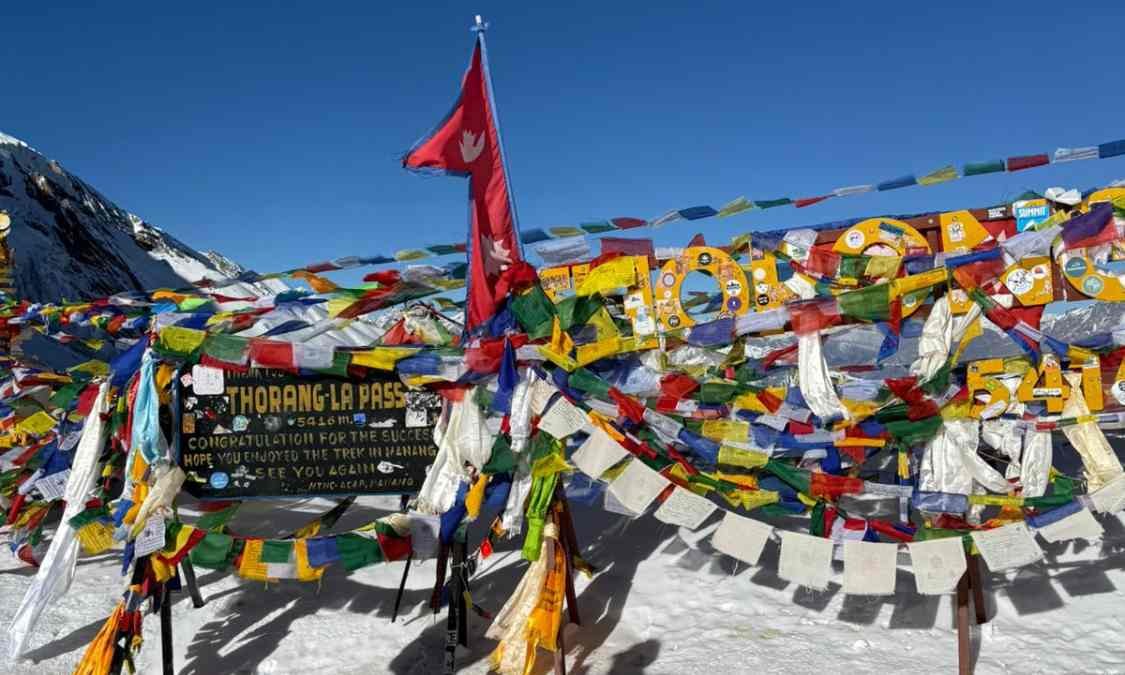
Crossing Thorong La is a long day — often 8 to 10 hours from Phedi, or shorter from High Camp — beginning in the dark with a headtorch and ending, if all goes well, with the first light striking the peaks across the Kali Gandaki. The air at 5,416 metres is thin enough that every step is deliberate; the trail is a wide, rocky moraine rather than a narrow path, and the final ramp to the cairns and prayer flags at the top is a genuine test of lungs more than legs.
The descent to Muktinath is long and knee-jarring but psychologically easy, because the hard part is behind you and the sacred town’s lodges, hot food, and (for some) the temple’s eternal flame await. Our Muktinath sacred site guide covers the cultural stop. Annapurna Circuit Treks times the crossing for first light and carries a satellite phone above 3,000 metres; the memory most trekkers keep is not the exhaustion but the silence and the scale at the top, with the whole Annapurna and Dhaulagiri ranges laid out like a map.
Muktinath and the Kali Gandaki Descent
Muktinath, at about 3,800 metres, is a threshold town where Hindu and Buddhist pilgrims meet trekkers, and its temple complex — with the eternal flame fed by natural gas and the 108 water spouts — is a genuine cultural anchor of the Circuit. Most trekkers spend a night, visit the site, and then move on, either by vehicle down the Kali Gandaki or by a short flight from Jomsom (about 2,740 m), a town known for its apple orchards and the world’s deepest gorge between Dhaulagiri and Annapurna.
The Kali Gandaki is also a fossil bed and a wind corridor, and the lower walk (or drive) passes Thakali villages like Marpha and Kagbeni with their whitewashed alleys and monastery hilltops. Our Thakali culture guide and Muktinath guide bring the culture alive. Annapurna Circuit Treks often folds a Jomsom–Muktinath cultural day into the Circuit so the trip ends not just at a pass but at a living heritage site, which is the Annapurna region at its most complete.
Costs in 2026: Honest Numbers
Costs in 2026 are best phrased as ranges. A guided lodge Circuit typically runs from around USD 60 to 90 per person per day all-in with a Pokhara operator including guide and porter, on top of your permits, flights, and the personal lodge bills for bed and meals; a fully private or camping version costs more, while a lean self-organised lodge walk can be done cheaper if you handle the logistics yourself (which the 2026 guide rule now complicates). Vehicle sections add cost but save days.
Our Annapurna trek cost guide and budget breakdown give the per-day maths, and Annapurna Circuit Treks quotes transparently with no hidden crew line. The realistic total for a 10-to-15-day guided Circuit in 2026, excluding international flights, lands in the low-to-mid four figures per person depending on private versus group and vehicle use. The value question is not ‘is it cheap’ but ‘is it run safely and locally’ — and that is where a Pokhara-base operator earns its fee.
Group Departures vs Private in 2026
The Circuit works in both formats. A fixed-departure group is cheaper and comes with built-in company and pre-booked peak-season beds; a private trek gives you your own dates, pace, and lodge choices, at a higher per-person rate. For the Circuit specifically, groups suit solo travellers wanting company and first-timers wanting structure, while private suits families, couples, and trekkers with specific altitude or pacing needs.
Our companion guide on choosing between group and private treks breaks this down in full, and Annapurna Circuit Treks runs both across the Annapurna region. The 2026 wrinkle is peak-season beds: October lodges fill fast, so a group with pre-booked rooms has a real edge, while a private trekker must book ahead through the operator. Either way the Circuit is safe and satisfying with the right plan — the format is a personal choice, not a quality difference.
Gear and Packing for the Modern Circuit
The gear list is stable year to year: broken-in waterproof boots, a warm layered system, a sleeping bag rated near freezing or below, trekking poles, a daypack, and a rain shell. Much can be rented or bought in Pokhara before you leave. The 2026 addition is less about gear and more about using it wisely given the road dust — a buff or light mask for the vehicle sections, and spare bags to keep electronics clean, are small comforts that pay off.
Our gear rental in Pokhara and packing list guides cover the full kit. Annapurna Circuit Treks fits your gear during the Pokhara arrival day so nothing is untested on the trail. The non-negotiables remain boots and a sleeping bag: cold feet and a cold night erode morale faster than any hill, and the Circuit’s high nights — Phedi, High Camp, Muktinath — are cold enough that a rented bag rated to minus ten is worth every rupee.
Food and Water on the 2026 Circuit
The menu is the familiar trekking rhythm: dal bhat lower down, narrowing to noodles, potatoes, and pancakes above 3,500 metres as everything is carried up by porter or donkey. Vegetarians eat well; vegans and the gluten-free find it harder higher up. Water must be treated, filtered, or bought — stream water is contaminated — and a filter bottle or purification tabs are smart given the cost and plastic of bottled water.
Our traditional food guide and drinking water and hygiene guide are essential reading. Annapurna Circuit Treks briefs every Circuit client on eating little and often, salting food to replace sweat loss, and carrying a filter bottle. The trekkers who struggle on the Circuit are almost always the ones who under-ate or under-drank, not the ones who undertrained — the trail feeds you if you let it, and the dal bhat refill is your friend at altitude.
Safety, Insurance and Emergency Response
Safety on the 2026 Circuit rests on four legs: a licensed guide, travel insurance that covers helicopter evacuation, a sensible altitude profile, and the HRA clinic chain. The Himalayan Rescue Association runs a clinic at Manang (about 3,540 m) and another at Pheriche, staffed in the peak seasons, and they are the first port of call for altitude illness. Evacuation, if needed, is by helicopter to Pokhara or Kathmandu, which is why insurance is mandatory in practice if not always by law.
Our trek safety overview, trekking emergency guide, and travel insurance 2026 guide cover the chain. Annapurna Circuit Treks carries a satellite phone above 3,000 metres on every Circuit and briefs clients on the symptoms to report. The pass is walkable for almost anyone who has acclimatised, and the region’s safety infrastructure, funded partly by your ACAP fee, is among the best in the Himalaya — but it only works if you use it early, not after you are already in trouble.
Getting There: Pokhara as the Gateway
Pokhara is the logical base for the 2026 Circuit. You reach it by a roughly 25-minute flight from Kathmandu or a 6-to-7-hour drive, and from Pokhara the roadheads toward the Marsyangdi are a few hours’ drive, compressing what used to be days of walking into a morning. Pokhara is also where you complete permits, fit gear, meet your guide, and — crucially — recover afterward by the lakeside with a wellness day.
Our how to get to the Annapurna region and lakeside wellness base guides frame the gateway and the recovery. Annapurna Circuit Treks is based in Pokhara precisely because it puts us on the Circuit’s doorstep: we hand you to the trail in the morning and welcome you back to a lakeside massage and a hot shower days later. The Circuit is a loop that begins and ends not on the pass but in Pokhara, and treating the city as part of the trip, not just transit, improves the whole experience.
Combining the Circuit with Other Annapurna Treks
The Circuit is often the anchor of a longer Annapurna journey. Trekkers combine it with Annapurna Base Camp (about 4,130 m) for a grand traverse, or pair the Jomsom–Muktinath end with a Poon Hill (3,210 m) or Mohare forest walk for a gentler finish. The region’s routes interlock like a lattice, so a two or three-week trip can bag several highlights without repeating ground.
Our three-week grand traverse, Circuit versus ABC, and Khopra Ridge guides show the combinations. Annapurna Circuit Treks designs these multi-route arcs from Pokhara, using vehicles to leap between trailheads and walking the scenic cores. The 2026 Circuit need not be a standalone; it can be the spine of a fuller Annapurna immersion, especially for travellers who have come a long way and want the region’s range — from subtropical forest to high pass to sacred town — in one continuous journey.
Why Book the 2026 Circuit with a Pokhara Operator
The case for a local Pokhara operator is concrete in 2026. We complete your permits on arrival, fit your gear, assign a licensed guide who knows the current road and trail state week to week, carry a satellite phone above 3,000 metres, pre-book peak-season lodges, and turn the trip around at the first serious altitude symptom. The roads change the logistics yearly, and a base-operator who drove the Marsyangdi last week knows which sections to walk and which to skip.
Our how to choose an operator guide and why local guides matter explain what to verify. Annapurna Circuit Treks, run by Anish Maharjan from Pokhara, treats the Circuit as our backyard — which it is — and that local knowledge is the difference between a generic itinerary and one tuned to the mountain’s actual condition this season. Book the 2026 Circuit with us and the road, the pass, and the paperwork become our problem, not yours.
Common 2026 Pitfalls to Avoid
The pitfalls are consistent. First, trying to walk every road mile and burning out on dust before the mountains. Second, skipping the Manang rest day and attempting the pass under-acclimatised. Third, under-budgeting for the vehicle sections and the lodge bills. Fourth, booking a peak-season departure without pre-booked beds. Fifth, treating the guide mandate as a box to dodge rather than a safety asset.
Our is the Annapurna trek safe guide and trek safety overview address the risks directly. Annapurna Circuit Treks pre-briefs every 2026 Circuit client on these five errors, because naming them in Pokhara prevents them at 4,000 metres. The Circuit is forgiving of honest mistakes made slowly, but the road and the altitude together punish arrogance — and the trekkers who come home with the best stories are the ones who planned the walk as it now is, not as it was written about a decade ago.
A Sample 14-Day Circuit-with-Tilicho Plan
For trekkers with time, here is a fuller shape: Days 1–2, Pokhara arrival, briefing, drive to roadhead and walk to a lower village. Days 3–5, walk the gorge to Chame and on toward Manang. Day 6, Manang rest with Ice Lake hike. Days 7–9, detour to Tilicho Lake (about 4,949 m) and back, or over Mesokanto. Day 10, walk to Thorong Phedi. Day 11, cross Thorong La to Muktinath. Day 12, explore Muktinath and the Kali Gandaki culture. Day 13, vehicle or flight toward Jomsom and out. Day 14, return to Pokhara with a lakeside wellness recovery day.
That is the 15-day Circuit with Tilicho in spirit — a two-week immersion that takes in the pass, the lake, and the sacred town without a single wasted transit day. Annapurna Circuit Treks tunes the day count to your fitness and the season’s road state. The sample proves the 2026 Circuit’s enduring truth: the mountains have not changed, only the approach to them, and a well-planned walk still delivers one of the great journeys on the planet, from Pokhara’s lake to Thorong La’s wind and back.
Connectivity, Apps and Staying in Touch
A practical 2026 question is communication. Mobile coverage on the Circuit is patchy but real: the lower valleys and the larger towns like Manang and Jomsom have 4G in places, while the high pass and the road-free stretches fall silent. A satellite phone or a personal tracker is the reliable backstop above 3,000 metres, and Annapurna Circuit Treks carries one on every Circuit departure so your family can be reassured and an emergency can be called without hunting for a signal.
Our connectivity on the trail guide and best travel apps and maps cover the practicalities — offline maps, a downloaded route, and a messenger that works on weak data. The honest expectation is intermittency: tell people at home you will be offline for stretches, and embrace it, because the Circuit’s gift is partly the disconnection. The mountain does not care about your inbox, and the trekkers who enjoy the walk most are the ones who let the signal go dark above the tree line and returned to the world refreshed at Pokhara.
Responsible Trekking: Treading Lightly in 2026
The Circuit’s popularity is both its lifeblood and its threat, and a 2026 trekker shares the responsibility for keeping the route intact. The simple rules: carry a filter bottle to avoid single-use plastic water, pack out what you pack in, respect the bukhari stoves and the wood they burn by choosing lodges using solar or gas, stay on the trail to protect the fragile alpine soil, and give genuinely to the communities rather than haggling every rupee with the family feeding you.
Our reducing plastic on the trail and offsetting your trek footprint guides turn good intentions into habit, and is the Annapurna Conservation Area explains how your ACAP fee funds the rangers who protect it. Annapurna Circuit Treks audits waste on every trip and briefs clients in Pokhara, because the operator that treats the Circuit as a resource to milk is the one helping degrade it. The considerate trekker — group or private — leaves the pass as clean as the first 1990s walker found it, and that stewardship is the quiet contract every Annapurna visitor signs by buying a permit.
Frequently Asked Questions
What is the Annapurna Circuit like in 2026 with the roads?
The Circuit now blends walking and driving: you use a 4×4 for the dusty, road-affected lower miles and walk the scenic high sections around Manang, Thorong and Muktinath. The high core of the trek is as magnificent as ever, and the road actually improves rescue and re-supply access. Annapurna Circuit Treks builds the Circuit this way so you walk the mountains and drive the dust — the practical 2026 formula.
Do I need a guide and permits for the 2026 Circuit?
Yes. Since 2023 a licensed guide is mandatory in the Annapurna Conservation Area, and you need the ACAP entry permit and the TIMS card, both arranged in Pokhara on arrival. Annapurna Circuit Treks completes all paperwork during your briefing so you reach the first checkpoint with stamps in order. The guide mandate is non-negotiable and, on a route this serious, a genuine safety asset.
When is the best time to trek the Circuit in 2026?
Autumn (October to November) gives the clearest skies and most reliable pass crossing but the busiest lodges; spring (March to May) brings rhododendrons and fewer crowds. Winter snowbinds the high pass for all but experienced trekkers, and the monsoon is wet and landslide-prone on the access roads. Annapurna Circuit Treks schedules most Circuit departures for the dry halves of spring and autumn.
How hard is the Thorong La crossing?
Thorong La at 5,416 metres is a long day — often 8 to 10 hours — but not technical; the challenge is altitude and the early start, not climbing skill. The key is a slow build via a Manang rest day and an early-morning crossing after sleeping at Phedi or High Camp. Annapurna Circuit Treks carries a satellite phone above 3,000 metres and turns the group around if altitude symptoms appear, so the pass is walkable for almost anyone who has acclimatised.
How much does the Annapurna Circuit cost in 2026?
A guided lodge Circuit typically runs from around USD 60 to 90 per person per day all-in with a Pokhara operator including guide and porter, plus permits, flights, and personal lodge bills; private or camping versions cost more, lean self-organised walks less. Vehicle sections add cost but save days. Annapurna Circuit Treks quotes transparently, and the realistic total for a 10-to-15-day guided Circuit in 2026, excluding international flights, is in the low-to-mid four figures per person.
Plan Your Annapurna Adventure
The Annapurna region rewards preparation. Annapurna Circuit Treks runs fixed-departure and fully custom Annapurna treks from our Pokhara base — licensed guides, community lodges, and transparent 2026 pricing. Browse our [Annapurna trekking guides & packages](https://annapurnacircuittreks.com/annapurna-trekking-guides-packages/) or talk to a [local expert](https://annapurnacircuittreks.com/contact-us/) before you fly.
*— Annapurna Circuit Treks, Pokhara*