


What a 4×4 Drive Camping Trek Means
A 4×4 drive camping trek in the Annapurna region blends two travel styles most visitors keep separate: the comfort and speed of a private jeep on the rough mountain roads, and the quiet freedom of sleeping in your own tent beside a river or beneath a wall of peaks. Annapurna Circuit Treks runs these trips from Pokhara because they solve a genuine problem — many travellers love the high valleys of Annapurna but cannot, or do not wish to, walk every day for two weeks. The vehicle carries the heavy camp, the kitchen and the beds while you drive the dramatic road sections and walk the scenic stretches that truly reward your legs.
The result is a trek that reaches places buses and teahouses miss yet spares you the dawn-to-dusk marching of a classic teahouse circuit. For photographers, families with mixed abilities and travellers short on leave, the drive-camping format turns the Annapurna massif into something reachable without sacrificing the wilderness feel. You get the best of both: the road where it is dull, the trail where it is glorious, and a camp that moves with you to the finest view each night under the stars.
Why Drive the Roads Instead of Walking
The road network around Annapurna has grown fast, and while purists mourn lost wilderness, the practical trekker sees opportunity. Driving the long, dusty switchback road sections between Pokhara, Beni, Tatopani, Jomsom and Muktinath saves three or four hard walking days and spares knees and lungs for the sections that matter. A 4×4 also lets you chase weather: if cloud fills one valley you can reposition to another viewpoint the same afternoon, something a walking group cannot do.
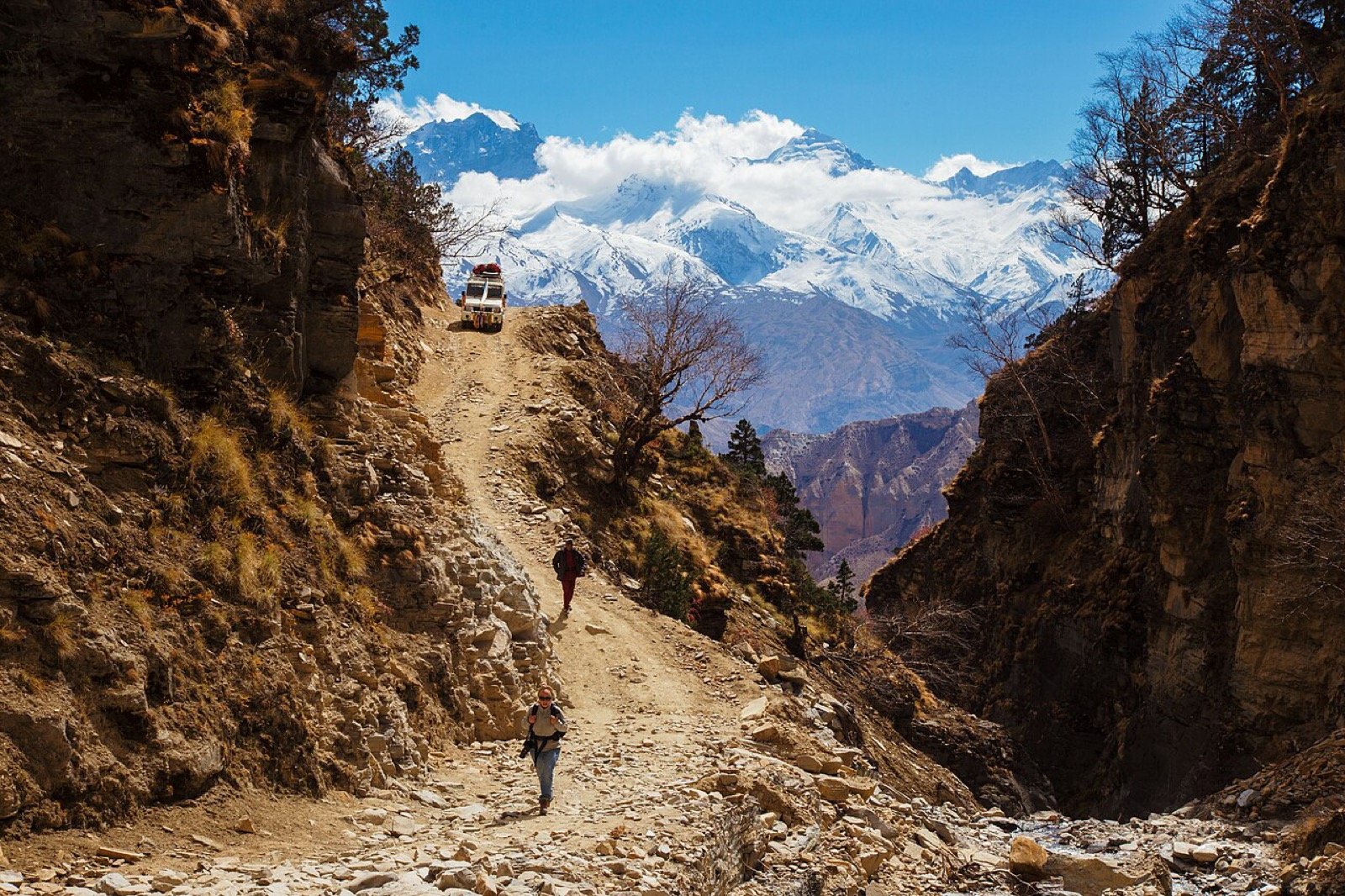
Annapurna Circuit Treks uses sturdy 4×4 vehicles because the roads are unpaved, washed out in places and crossed by landslides in the monsoon, so a two-wheel-drive car is a liability. The drive itself is part of the experience — the Kali Gandaki gorge, the apple orchards of Marpha and the wind-carved cliffs near Muktinath are all roadside spectacles. Driving the dull bits means you arrive fresh for the walks, the sunrise points and the high camps that make the trip memorable rather than merely completed.
Where the Camps Are Pitched
Camping gives you a freedom no teahouse can: you sleep exactly where the view is best. Annapurna Circuit Treks pitches camps at riverside meadows near Tatopani, on the apple terraces above Marpha, beside the Kali Gandaki at Kagbeni and on open ground below Muktinath where the dawn light hits Dhaulagiri. On the eastern side we camp above Pokhara toward Australian Camp and on the ridge above Dhampus, and on the Manang approach we use grassy flats near Khangsar that walking groups pass by.
Each camp is chosen for flat ground, water access, wind shelter and a clear sightline to a peak. Because the vehicle brings a mess tent, a dining table, foam mattresses and a kitchen, the camp is warmer and better fed than many lodges. You hear the river instead of a neighbouring snorer, and you wake to a kettle already boiling, with no other trekkers in sight and the first light already touching the ice across the valley.
The Manang and Tilicho Drive Approach
The single best use of a 4×4 in Annapurna is the drive up the Marsyangdi and into Manang, the broad, arid valley at about 3,540 metres that acts as the acclimatisation hub for the high country. Driving to Manang spares you five days of road-walking that the new jeep track now permits, leaving your legs for the worthwhile walks: the climb to the Ice Lake and the ridge above Gangapurna. Annapurna Circuit Treks runs the 7-day 4×4 drive to Manang and Tilicho that places you in Manang with energy to spare.
The vehicle then reaches the Tilicho Lake detour base at 4,949 metres, one of the highest large bodies of water on earth, a turquoise mirror beneath a wall of ice that is far easier to enjoy when you have not spent a week walking to reach it. The drive also means a real bed and a hot meal are never more than a short reposition away, which keeps the high-altitude days safe and the mood relaxed even as the air thins and the temperature drops after dark on the high meadows.
Camping Gear and the Mobile Kitchen
A self-respecting camping trek lives or dies by its kit, and Annapurna Circuit Treks travels with a full mobile kitchen, a mess tent, dining chairs, foam mattresses, warm sleeping bags and a toilet tent — the unglamorous items that separate a comfortable camp from a cold ordeal. The kitchen carries a gas stove, a pressure cooker, a supply of staples and fresh vegetables bought in Pokhara or Marpha, so meals are hotter, cleaner and more varied than the dal bhat repeat of a busy teahouse.
Tents are double-skinned to shed the cold and the dew, and the crew erects them before you arrive so the camp is ready at day’s end. The 4×4 carries all of this, which is why the drive-camping format works where a porter-only camp would collapse under the weight. Guests need only a small daypack for the walks; the vehicle does the hauling, and our gear rental guide lists what we supply versus what you should bring from home.
Food on a Drive Camping Trek
Eating well at altitude is half the battle of feeling good, and a camping trek with a real kitchen wins decisively over the limited teahouse menu. Annapurna Circuit Treks serves cooked breakfasts of porridge, eggs and toast, hot lunches on walking days, and dinners of rice, vegetables, lentils and the occasional treat baked in the camp oven — apple crumble using Marpha apples is a trip legend. Because the vehicle resupplies at markets along the route, the food is fresher than on a remote walking trail.
We keep a constant supply of safe drinking water through filtration and boiling, and our drinking water and hygiene guide explains the camp protocol. Vegetarians and most dietary needs are easy to meet when the kitchen is your own, and the shared meals under the mess tent become a social core that teahouse dining rooms rarely match. The cook becomes a beloved member of the party, and the evening meal is something to look forward to rather than endure after a hard day on the trail.
Who This Trip Suits Best
A 4×4 drive camping trek is ideal for travellers who want the high Himalaya without the physical demand of a full walking circuit: older trekkers, families with children too young for long days, photographers who need to carry heavy lenses, and anyone on a tight schedule who still wants wild camps. Annapurna Circuit Treks also recommends it for groups with mixed fitness, because the vehicle lets the keen walkers stride out while the rest roll ahead and meet at camp.
It suits first-time visitors to Nepal who are unsure how their bodies will handle altitude, since the drive lets us retreat to a lower elevation quickly if needed. It is less suited to purists who want to walk every step or to very tight budgets, because the vehicle, fuel and camp crew cost more than a solo teahouse walk. For the right traveller, though, the format is the sweet spot — genuine mountain wilderness, real campfires, and none of the exhaustion that can shadow a long foot march.
Sample 7-Day Drive Camping Itinerary
A typical Annapurna Circuit Treks drive-camping plan runs like this: day one drives Pokhara to Tatopani with a camp by the hot springs; day two continues up the Kali Gandaki to Marpha for apple country and a camp on the terraces; day three reaches Kagbeni and camps beside the wind-carved river; day four drives to Muktinath for the sacred site and a high camp below the temple; day five turns back down to Jomsom with a walk to the white monasteries.
Day six drives toward Manang or returns via the scenic Beni road with a riverside camp; day seven returns to Pokhara. Walkers can add the Ice Lake acclimatisation hike from Manang, the Australian Camp walk above Pokhara, or a night at World Peace Pagoda for a lake sunset. The shape is flexible — the vehicle means the plan bends around weather and energy rather than locking you to a fixed foot schedule that ignores how the group actually feels each morning.
Altitude and Acclimatisation on Drives
Driving high is a double-edged sword: you reach altitude fast, which is risky, but you can also descend fast, which is the cure for sickness. Annapurna Circuit Treks plans drive days so you do not gain more than about 500 metres of sleeping altitude per day where possible, and we build acclimatisation walks like the short climb above Manang to trigger the adaptation the body needs. The vehicle means that if anyone feels unwell at 3,500 metres, we simply drive down a thousand metres and let them recover, a safety option a walking group lacks.
Our acclimatisation strategy for Tilicho and Thorong and the altitude sickness guide set the rules we follow. We carry a pressure bag and oxygen on the high sections, and our guides are trained to read the early signs and act. Done right, the drive-camping format is actually safer for uncertain acclimatisers than a foot march, because retreat is always a short ride away rather than a long, painful descent on exhausted legs in thinning air.
Permits, Roads and the Conservation Area
Every drive camping trek still needs the ACAP permit and TIMS card, because the vehicle enters the Annapurna Conservation Area exactly as walkers do, and checkpoints at Beni, Tatopani and Kagbeni will ask. Annapurna Circuit Treks handles the paperwork in Pokhara before departure so the gates are smooth. The fees fund the rangers, the trail repairs and the community projects that keep the region liveable, and our conservation area guide explains where the money goes.
Note that the new jeep roads have changed the feel of some valleys, and we choose camp spots away from the dust where we can. Upper Mustang and the Nar-Phu area beyond remain restricted and need a special permit plus a licensed guide, so they are off the standard drive loop. Knowing the rules keeps you legal and the mountains protected, and our 2026 permits guide lists every fee and document you need before the wheels start turning on the first morning out of Pokhara.
The Kali Gandaki and Muktinath Drive
The jewel road section of any Annapurna drive trek is the Kali Gandaki, the river that separates Dhaulagiri from the Annapurna range and carves the deepest gorge on the planet. Annapurna Circuit Treks follows it from Tatopani through Ghasa, Marpha and Jomsom to Kagbeni and Muktinath, a drive that moves from subtropical heat to a high, windy, Tibetan-style plateau in a single day. Marpha is famous for its white-washed houses and apple brandy; Jomsom is the windy administrative town; Kagbeni is a medieval-feeling village at the gate of restricted Upper Mustang.
Muktinath at 3,800 metres is a sacred site for both Hindus and Buddhists, and camping along this corridor means you experience the cultural shift from Hindu lowlands to Buddhist high country at ground level, something a flight skips entirely. Our Muktinath temple guide covers the pilgrimage, and the drive lets you arrive unhurried and overnight near the temple for the calm early-morning visit when the light is soft and the crowds have not yet arrived at the gompas.
Photography and the Roadside Viewpoints
A 4×4 is a photographer’s friend: you can stage at a viewpoint, wait for light, and move when the moment passes. Annapurna Circuit Treks knows the pull-offs where Dhaulagiri fills the windscreen, where the Annapurna range stacks behind Pokhara, and where the early sun turns the Kali Gandaki cliffs gold. Because the camp travels with you, you can shoot the Milky Way from a dark riverside meadow then sleep warm ten steps from the tripod — our night sky and Milky Way guide names the best dark camps.
The drive also reaches high points like the ridge above Dhampus for the classic fishtail-and-Phewa view, and the road to Manang for the Gangapurna glacier front. Heavy lenses and a drone where legal are easy to carry in the vehicle, removing the weight penalty that limits walking photographers. For travellers whose main goal is images rather than miles walked, the drive-camping format is simply the most productive way to spend a week in Annapurna, with the camp as a mobile base and darkroom.
Comparing Drive Camping With Teahouse Treks
The honest trade is comfort and reach against immersion and cost. A teahouse trek, as our tea house versus camping guide explains, puts you among lodge families every night and costs less, but you walk every mile and eat a repeating menu. A drive camping trek costs more for the vehicle and crew, but you skip the dull road miles, sleep in better air and eat better food. Annapurna Circuit Treks offers both and will tell you straight which fits: if your legs are strong and your budget tight, walk; if your time is short or your group is mixed, drive and camp.
The landscapes are identical — the difference is how you meet them. Many guests do a hybrid: drive the approaches, walk the high sections, camp the scenic nights. Our camping tours guide and the 4×4 Manang Tilicho package are the entry points. Neither style is superior; the right one gets you into the mountains happy, healthy and with the memories you came for, whether those memories are of a hot shower or a cold river and a tent flap glowing with the first light.
Best Seasons for the Drive
Timing decides everything on a mountain road. Autumn, from late September to November, is the safest and clearest window for a 4×4 trek — dry roads, stable weather and the sharpest views of Dhaulagiri and Annapurna. Spring, March to May, brings warm lowlands and blooms up high, though afternoon winds on the Kali Gandaki can be fierce and the dust on the lower tracks thick after the dry winter.
Winter, December to February, sees snow on the high passes and very cold camps, but the low routes around Pokhara and Tatopani stay open and quiet. The monsoon, June to September, is the riskiest: landslides close roads, the rivers swell and the views vanish in cloud, so Annapurna Circuit Treks generally avoids drive treks then. Our best time to trek guide and the autumn article and spring rhododendron article break the months down so you can pick the window that suits both road and view.
Safety, the Crew and Emergency Reach
A camping trek stands on its crew, and Annapurna Circuit Treks travels with a licensed guide, a cook, assistants and a driver who knows the mountain roads — a team a solo jeep hire lacks. The guide manages altitude calls and culture; the cook runs the kitchen and water safety; the driver handles the vehicle on roads that punish strangers. Because we carry a satellite phone and, on high sections, oxygen and a pressure bag, an emergency can be managed and, if needed, a helicopter summoned from a road point far faster than from a remote trail.
Our trek safety overview and emergency what-to-do guide set the protocol; the HRA clinic guide notes the Manang post we use for checks. The drive format means the nearest road is never far, so evacuation is a ride not a carry, which is the single most reassuring feature of the 4×4 camping style in the Annapurnas and a major reason families with older members choose it over a remote walking circuit.
Packing for a Drive Camping Trek
Packing for this format is lighter than a walking trek because the vehicle carries the camp, so your daypack holds only layers, water, camera and a few personal items. Annapurna Circuit Treks supplies the sleeping bag, mattress and tent, and our packing list names the rest: a wicking base layer, a fleece, an insulated jacket, a shell, a warm hat and gloves, good shoes for the walks, sunscreen, a headtorch and personal medication. Bring a small daypack and a duffel for overnight items; the duffel rides in the truck.
Because camps can be cold at night even in autumn, pack for near-freezing even if the days are warm. A refillable bottle with purification cuts cost and plastic — our reducing plastic guide explains the camp rule. The light pack is a quiet joy: the truck eats the weight and you arrive at each camp with shoulders free and legs ready for the evening walk to the viewpoint rather than aching from a load carried all day up a switchback.
Cost Picture for 2026
A 4×4 drive camping trek costs more than a teahouse walk because you are paying for a vehicle, fuel, a driver and a camp crew, but less than a luxury lodge trip with private rooms and hot showers on tap. Annapurna Circuit Treks quotes the all-in price — vehicle, fuel, permits, camp, kitchen, guide, porter-drivers and meals — so the only extras are personal snacks, drinks and tips. The vehicle also saves you the Jomsom flight that many walking groups add, which offsets some cost.
Our trek cost guide and budget breakdown show the per-day shape; the drive-camping style sits in the upper-middle of the range, fair for the comfort and reach it buys. Travelling as a small group divides the vehicle cost and lowers the per-person rate, so four sharing a 4×4 is markedly cheaper per head than two. Budget a contingency for hot showers in towns and you stay predictable from Pokhara to Pokhara on the final evening.
Booking and Customising Your Drive
Because every drive camping trek is built around a vehicle, it is easy to customise: more walk days here, more drive days there, a camp at this viewpoint, a night in that village. Annapurna Circuit Treks plans each trip from your dates, fitness and interests, and our how to choose an operator guide explains what a good operator provides. We brief you in Pokhara, check gear, hand over permits and roll out when the weather is right.
The 7-day Manang Tilicho drive is the template; the 15-day circuit with Tilicho is the longer version for those who want to walk the high pass too. Tell us if photography, family or pure scenery leads your trip and we shape the camps accordingly. Booking through a Pokhara base means the vehicle, the crew and the knowledge are local, not outsourced, and the plan bends to the mountain rather than the other way around when the weather turns.
Road Conditions and Driver Skill
The roads of the Annapurna region are not roads in the sealed sense most travellers know, and the driver is as much a guide as the person riding shotgun with the map. Annapurna Circuit Treks uses drivers who have run the Kali Gandaki and the Marsyangdi corridors for years, because a wrong line in a landslide rut or a stalled crossing of the Modi Khola can end a day or worse. The tracks wash out after the monsoon and freeze after the first snow, and the skill is in reading the surface, the weather and the load rather than in speed.
We brief guests that the 4×4 is a tool for the dull miles, not a racer, and that some sections are walked while the vehicle is repositioned ahead to spare the knees. The getting to Annapurna guide covers the transfer realities; the safety overview the vehicle checks we run before every departure. A good mountain driver is worth more than a fast one, and the calm, experienced hand at the wheel is the quiet reason our drive-camping trips return without drama while lone jeep hires get stuck above Kagbeni for a night.
Combining Drive With a Trek
The smartest use of the 4×4 is not to avoid walking but to choose when to walk, and Annapurna Circuit Treks plans hybrids that drive the road sections and walk the scenic ones. You might drive to the foot of the Ice Lake climb, walk the ridge above Manang for the acclimatisation and the view, then drive back to a riverside camp rather than descending on foot. The Ice Lake acclimatisation hike is built for exactly this, as is the Australian Camp walk above Pokhara where the vehicle waits at the top.
Hybrids suit mixed groups — the keen walkers stride out, the rest roll ahead and meet at the meadow — and they keep the best of both styles without the exhaustion that a full foot circuit can bring. Our 7-day Manang Tilicho drive is the template; the 15-day circuit with Tilicho the longer version for those who want the high pass on foot as well. Tell us your fitness split and we design the drive-to-walk ratio so nobody is bored and nobody is broken by the third day out of Pokhara.
The Drive-Camping Verdict
The 4×4 drive camping trek is not for everyone, and Annapurna Circuit Treks says so plainly: if you want to walk every step and count every pass, take a teahouse circuit; if you want the high valleys, the lakes and the sacred sites with comfort and a real bed most nights, drive and camp. The format suits families, photographers, first-timers and the time-pressed far better than a foot march, and it keeps the wild edges that the all-road trips lose. The vehicle is a tool, not a cheat — it carries the camp to the view and leaves your legs for the walks that matter.
For the right traveller the drive-camping loop is the most relaxing, most photogenic and safest way to meet the Annapurnas, and the campfire under Dhaulagiri is a memory no lodge corridor can match. The road where it is dull, the trail where it is glorious, and a tent that moves with you to the finest view each night — that is the drive-camping promise, and it is the reason so many of our guests return to Pokhara asking when they can do the next one with us.
Frequently Asked Questions
Can beginners do a 4×4 drive camping trek in Annapurna?
Yes. Because the vehicle carries the camp and covers the long road sections, beginners and unfit travellers can still reach high valleys like Manang and Muktinath with only short walks. Annapurna Circuit Treks paces the drive days for gradual altitude gain and adds acclimatisation strolls, so the trip suits first-timers who would struggle on a full walking circuit. The key is honest communication about your fitness so we set the right mix of drive and walk.
Is camping in Annapurna safe at high altitude?
It is safe when the camp is sited and paced correctly. We keep sleeping altitudes modest, carry oxygen and a pressure bag on high sections, and can drive down quickly if anyone feels unwell. Our guides are altitude-trained and the vehicle means evacuation is a short ride, not a long carry, which makes drive camping safer than remote walking for uncertain acclimatisers who may need to descend fast.
What is included in the drive camping price?
The all-in price covers the 4×4, fuel, driver, licensed guide, camp crew, tents, mattresses, sleeping bags, mess tent, all meals on trek, permits and water treatment. Personal snacks, town hot showers, drinks and tips are extra. Annapurna Circuit Treks quotes this in writing so there are no surprises at the gate or the camp when the road turns rough.
When is the best season for the drive?
Autumn, late September to November, is the clearest and safest for the rough roads, with spring, March to May, a warm second choice. Winter works on lower routes, while the monsoon, June to September, brings landslides and poor views and is best avoided for driving. Our team checks conditions and can shift the plan day to day around the weather.
Do I need a guide for a drive trek?
Yes, and not only for the restricted zones. A licensed guide manages altitude, culture, permits and safety, and the conservation area expects one. Annapurna Circuit Treks supplies a local guide and a driver who knows the mountain roads, which is the difference between a smooth trip and a stranded one when a bridge washes out or a permit checkpoint appears.
Plan Your Annapurna Adventure
The Annapurna region rewards preparation. Annapurna Circuit Treks runs fixed-departure and fully custom Annapurna treks from our Pokhara base — licensed guides, community lodges, and transparent 2026 pricing. Browse our [Annapurna trekking guides & packages](https://annapurnacircuittreks.com/annapurna-trekking-guides-packages/) or talk to a [local expert](https://annapurnacircuittreks.com/contact-us/) before you fly.
*— Annapurna Circuit Treks, Pokhara*